Project Origin - Developed at King
Role - Game & Level Designer
Genre - Match 3 / Puzzle
Period - March 2017 - March 2021
Scope - Live game design and retention/engagement optimization


Disclaimer: - All visuals and examples are illustrative and reconstructed for portfolio purposes or publically available. No proprietary data, tools, or internal metrics are shown.
Scope & Impact
Live Game & Feature Design
Designed and shipped hundreds of levels across early and late progression.
Designed and co-designed gameplay systems, including the Sour Skull blocker.
Led a data-driven feature removal initiative that resulted in significatnt uplift in engagement, retention, and revenue.
Design Strategy & Quality
Reworked level-design approach to clarify feature purpose and usage across progression.
Used live player data to tune difficulty, pacing, and feature deployment.
Production & Tools
Led the design of internal tools that increased level production capacity by ~87%.
Improved documentation practices for long-term feature and content sustainability.
Leadership & Craft
Mentored interns and junior designers on design thinking and production workflows.
Planned and led workshops to improve level-design craft and knowledge sharing.
Delivered craft-level presentations internally and live demonstrations for the player community.
Design Slice A. – Sour Skull Feature
Problem: Standard blockers lacked strategic depth and sub-goals in endgame levels.
My Action
Conceived and led the Sour Skull blocker system.
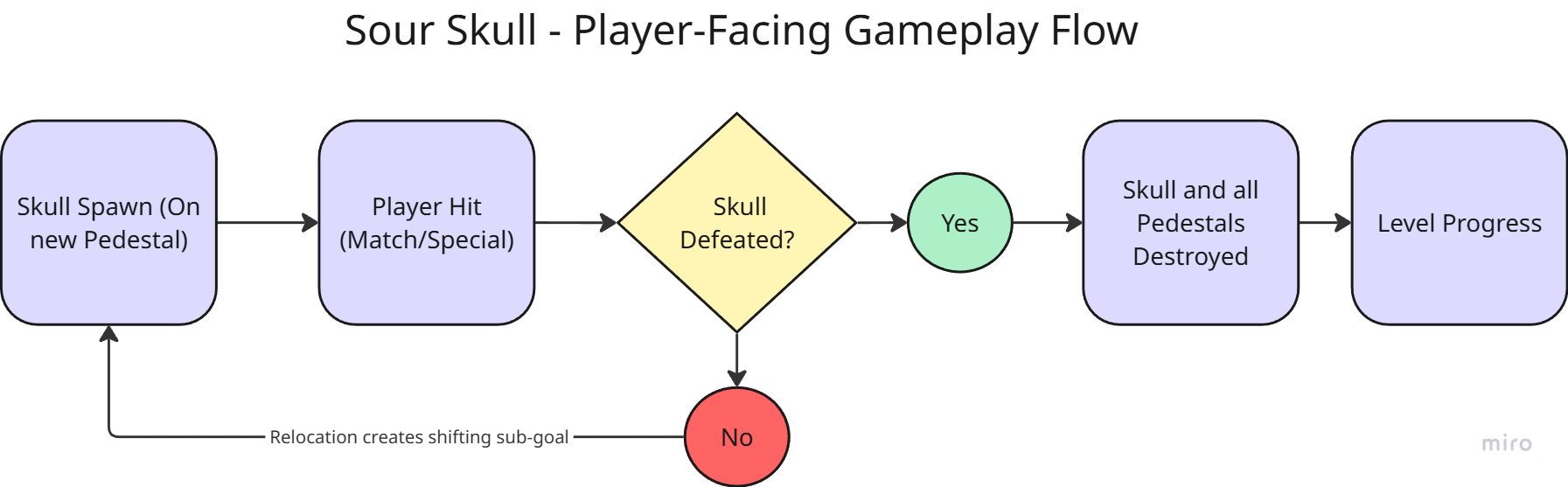
Defined its mechanics: teleporting target with diminishing health, core strategic objective in levels.
Designed related tutorial levels to teach mechanics organically.
Outcome/Impact
Integrated feature across levels; tertiary goals drove richer decision layers.
Player feedback indicated engagement with the mechanic; it became a repeatable design tool for later levels. (Place metric if available)

Sour Skulls first apperance, as a Tutotial pop-up.
Conceptual illustration — values and distributions are representative, not real player data.

5 Layers (Full Health)

4 Layers

3 Layers

2 Layers

1 Layer

Empty Pedestal (Gets Removed)
Level Design usage
Level 8056, shows how the Skull traverses in a set parth to create a structural progression in the level. Also, how its properties as a Lock with Licorice Swirls can crete a more focused an non-brekable level.
Tutorial 1 - Presents the Sour Skull and 2 Pedestal. Objective is to Destroy it. Teaches that the Skull can take Damage, can teleport and the Pedestals are destroyed with the Skull.
Tutorial 2 - More Pedestals are in use. Teaches that the Skull can take Special Effect damage. Also presents the Lock functionality of the Pedestals.
Tutorial 3 - More Pedestals then the Sour Skulls health points can be present. Showcases that any other features properties are active underneath it, in this case, Licorice Swirls under Pedestals will block special effects.
Design Slice B. – Retention & Feature Simplification
Problem
Certain legacy blockers - Mystery and Chameleon Candy - introduced heavy RNG, distorting difficulty metrics and making end-state readability unreliable in late progression levels and outdated design.
My Action
Identified two underused blockers (Chameleon Candy and Mystery Candy) contributing disproportionate randomness.
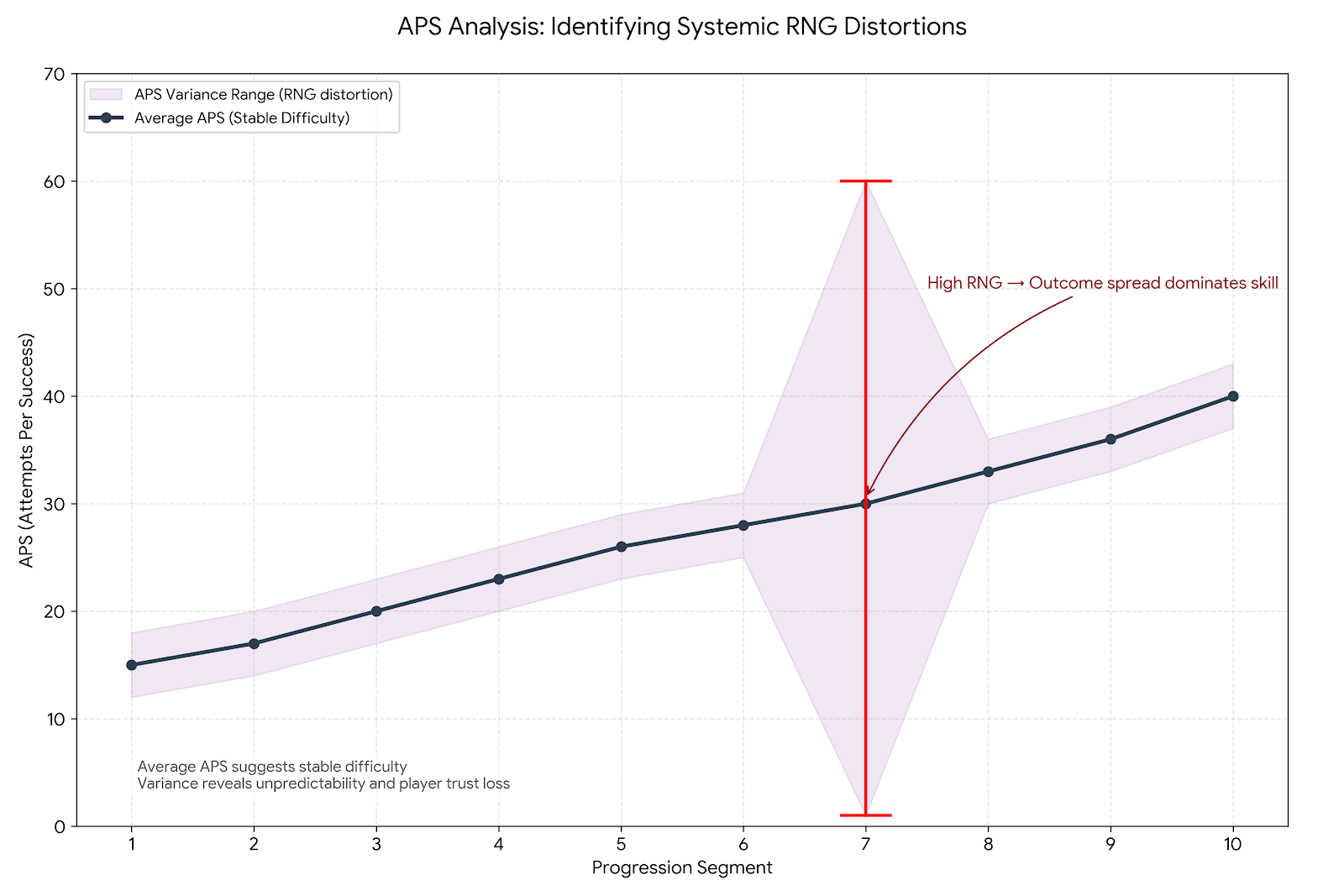
Analyzed APS data and confirmed extreme variance (wins on attempt 1 vs. 50 with no consistent pattern).
Hypothesized that RNG-driven opacity reduced player trust and decision clarity.
Led an A/B test removing these blockers from a progression segment.
We deliberately evaluated variance, not averages, as mean APS masked the RNG effect

Mystery Candy

Chameleon Candy
Case Study: APS Simulation
Conceptual example: Illustrating how RNG-heavy blockers can preserve acceptable average APS while dramatically increasing outcome variance.
Problem: Average APS appeared healthy in live data, but RNG-heavy mechanics caused extreme outcome variance, making APS unreliable as a signal of difficulty and masking player skill behind luck.
Design takeaway: Reducing RNG restored APS as a meaningful tuning signal and improved player trust in level outcomes.
Goal: reduce outcome variance so APS once again reflects player skill rather than luck.
Conceptual illustration — values and distributions are representative, not real player data.
Outcome / Impact
A/B test showed uplift in engagement and end-game purchase behavior.
Difficulty curves became more predictable and readable.
Project was greenlit; both blockers were fully phased out of live content within a month.
Design Slice C. – Scalable Level Pacing & Intent
Problem
At scale, performance metrics (APS, EGP) classified levels as “good” or “bad” without explaining design intent or supporting deliberate progression planning.
My Action
Mapped levels against key performance metrics (APS, EGP), revealing clusters with no meaningful design differentiation.
Introduced a level taxonomy (e.g., Puzzle, Explosive, Endurance) to label intent, not outcome.
Cross-referenced level types against performance data to understand which design intents succeeded in different progression contexts.
Case Study: Design Intent Predicts Performance
Conceptual example: Illustrating how RNG-heavy blockers can preserve acceptable average APS while dramatically increasing outcome variance.
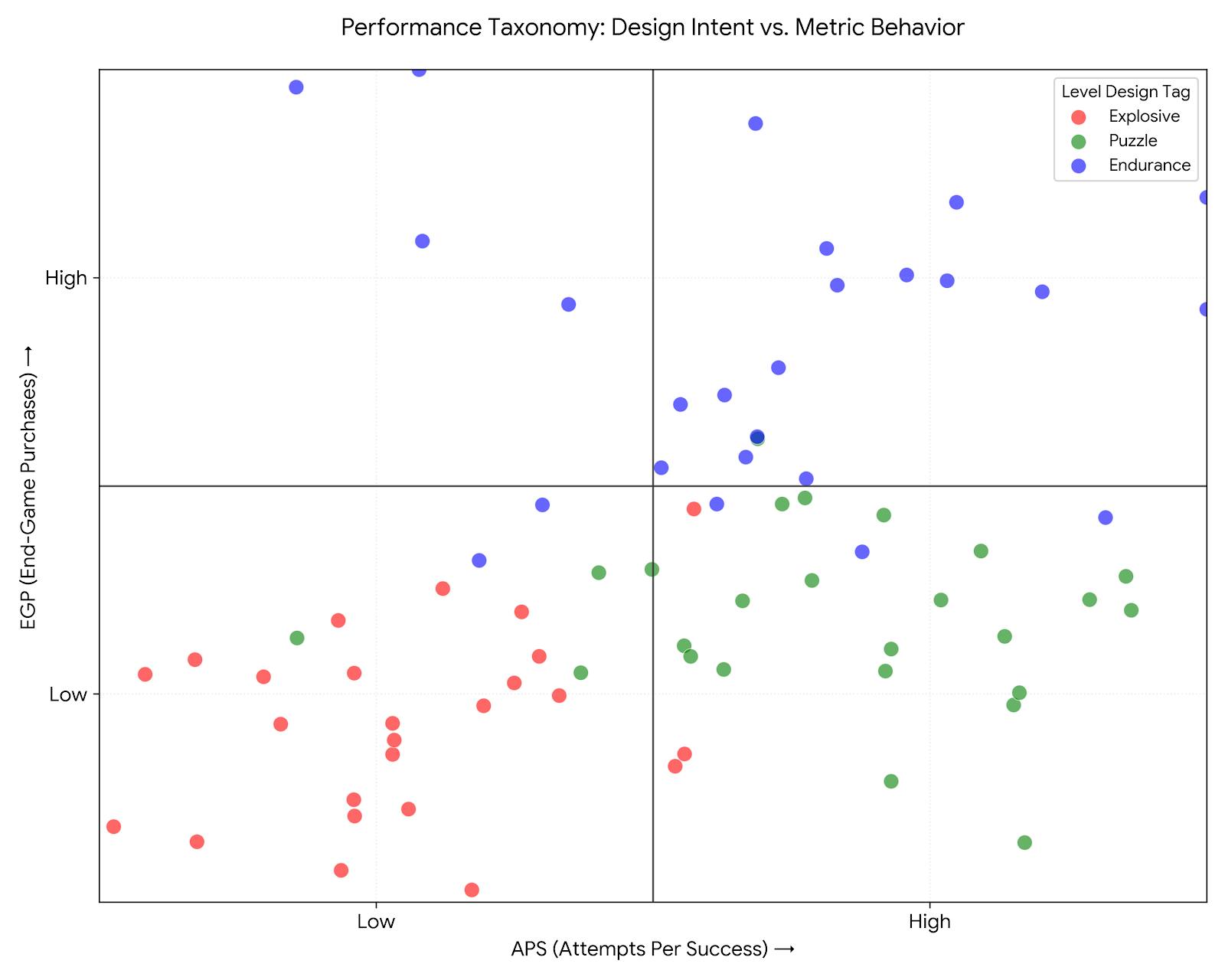
Levels are tagged by design intent (Puzzle, Explosive, Endurance) and evaluated using two live metrics:
APS — Attempts Per Success (difficulty signal)
EGP — End-Game Purchases (monetization pressure)
What the chart shows
Averages are misleading — APS and EGP can look healthy in isolation.
Design intent drives outcomes — level types consistently cluster into the same metric regions.
Issues are systemic — underperforming levels were predictable results of specific design patterns, not individual mistakes.
Quadrant interpretation
Conceptual illustration — values and distributions are representative, not real player data.
Low APS / High EGP
Friction without challenge. Often caused by unclear end-states or deceptive blockers.
Low APS / Low EGP
Low engagement. Typically overly explosive or passive designs with shallow decision-making.
Outcome / Impact
This framework allowed us to deliberately balance progression by intent, rather than retroactively fixing ‘bad’ levels.
Enabled deliberate pacing and variety across progression.
Improved ability to predict performance based on design intent.
Provided a shared design language for the team when evaluating and planning content.
High APS / High EGP
Endurance-focused levels. Strong monetization, higher fatigue risk if overused.
High APS / Low EGP
Skill-based puzzle levels. Difficult, readable, and perceived as fair.
Conclusion
4 years, from Berlin to Stockholm, +500 levels, 1 own in-game feature and other design projects.
At the time, my time at King was my longest job experience I had, longer than my University days. But as in University, I got to learn so much, meet so many passionate people and had so many opportunities to create and develop. Knowing that so many people get to experience my design is really heartwarming to me and I hope my content i Candy will pring someone joy. Fun fact, I even managed to leave a mark in the design craft, as more “puzzle” oriented design in both features and levels has been dubbed “Bräysy” levels. I am both proud and scared for that.
MISC. MEDIA APPERANCES


King Stockholm - 03/10/19